
When a serious commercial project enters electrical design, one decision separates ordinary lighting from professional lighting: whether we control luminaires with switches and analog dimmers, or whether we control them digitally over DALI. In 2026, that decision is no longer a debate. DALI won.
What is DALI?
DALI (Digital Addressable Lighting Interface) is the international standard for digital lighting control, defined in IEC 62386. Unlike traditional systems — on/off switches, phase-cut dimmers, analog 0-10V control — DALI lets every luminaire be individually addressable by software.
What does that mean in practice? The system knows how many luminaires exist, where they are, what they're named, what group they belong to, what scene they're running, and — critically — what state they're in, in real time.
Up to 64 luminaires per DALI bus, each with a unique address, wired with a single polarity-free pair. No complex wiring matrices, no per-circuit relays.
Why DALI is the future
Individual control of every luminaire. You can drive luminaire #17 to 38% and #18 to 72% at the same time, without adding a single extra wire. Regrouping luminaires happens in software, not on a ladder.
Smooth, precise digital dimming. The dimming curve is logarithmic — the human eye perceives it as perfectly linear. No flicker, no visible steps, no driver noise.
Bidirectional reporting. Every DALI driver reports its state to the system: on/off, current level, lamp failure, hours of use, driver temperature. This enables predictive maintenance: the system warns you before a luminaire fails, not after.
Circadian lighting (tunable white). The DALI DT8 profile controls color temperature in addition to brightness. It allows you to match light to the human biological rhythm: energizing cool white in the morning, warm and relaxed at end of day. Clinically documented to improve office productivity and hospital wellbeing.
Software scenes and groupings. Repurposing a floor in an office building? Reassign groups in the DALI software. No walls touched, no rewiring.
Universal and open. Hundreds of manufacturers — Tridonic, Helvar, Osram, Philips, Lutron, ABB, Eaton — all certified under the same standard. You're not married to a proprietary brand.
DALI-2 and DALI+: the new generation
DALI-2 (released in 2017) officially certifies presence sensors, control panels and application controllers as part of the standard — previously only drivers were certified. Today you can design a 100% DALI-2 system with no parallel cabling for sensors or wall panels.
DALI+ takes DALI wireless over Thread, Zigbee or Bluetooth Mesh. Useful for retrofits where new cable isn't an option, while preserving the same data model and commissioning tools.
Where does DALI shine?
Corporate offices. Circadian lighting + presence sensors + daylight harvesting yields up to 70% energy savings and measurable gains in focus and productivity. The canonical use case.
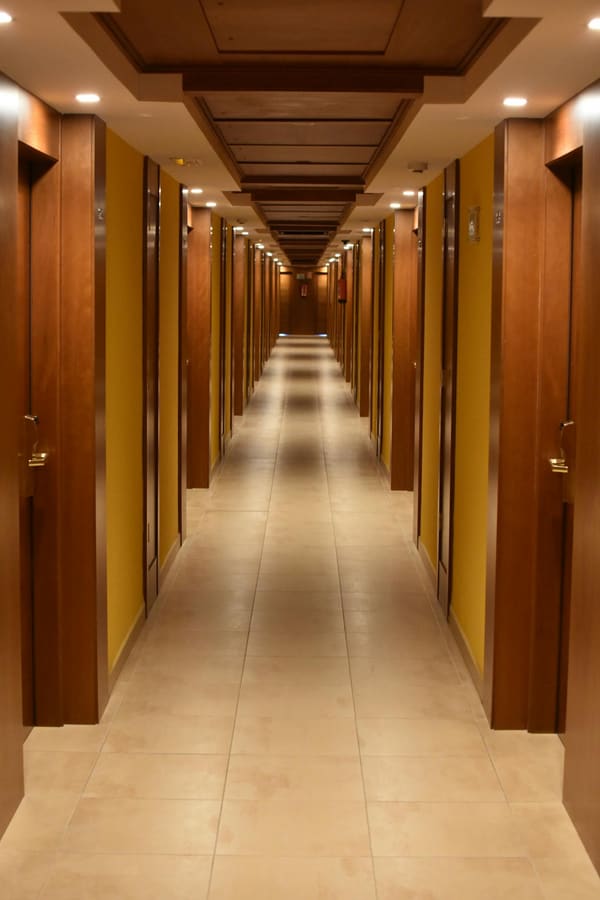
Hotels. Every room, hallway and lobby zone has its own scene. The manager switches to "event mode" from a tablet and the whole building responds in seconds.
Retail and showrooms. The product on the pedestal gets 3000K at 100%, the aisle 4000K at 60%, the storefront 2700K at 80%. Every zone lit with visual intent.
Hospitals and clinics. Hallways with adaptive light by time of day. Operating rooms with pre-calibrated scenes. Patient rooms with individual control and therapeutic color temperature.
LEED / WELL / EDGE buildings. Credits for dynamic lighting, automatic control and consumption reporting practically require a well-designed DALI system.
DALI + KNX: the premium-project duo
In high-end commercial projects you don't choose between DALI and KNX — you use both. KNX handles the building's overall architecture (HVAC, blinds, access, security, energy). DALI handles the fine lighting layer with dimming, color and reporting. KNX-DALI gateways let every KNX scene trigger DALI changes with single-luminaire precision.
At DiraSmart we design this integration as one single system. The end client's app doesn't distinguish where KNX ends and DALI begins — there is one experience, one interface.
When DALI is NOT worth it
Technical honesty: in a residential home with 10–15 luminaires, DALI is overkill. The cost curve of DALI drivers vs analog drivers only pays off above ~40–50 light points, or when there are professional requirements (circadian, large-scale scenes, fault reporting, LEED/WELL certification). For small residential, pure KNX or smart actuators solve it just as well.
Conclusion
Professional lighting stopped being "on and off". Today it's a channel of wellbeing, energy savings, brand experience and architectural differentiation. DALI is the only mature, standardized, open technology that delivers all of that at scale — and the only one with a real 20+ year horizon.
At DiraSmart we design DALI projects integrated with KNX in Panama. If you're planning an office, hotel, clinic or retail space, let's talk before you close the electrical phase — that's where the real savings and design opportunity live.