
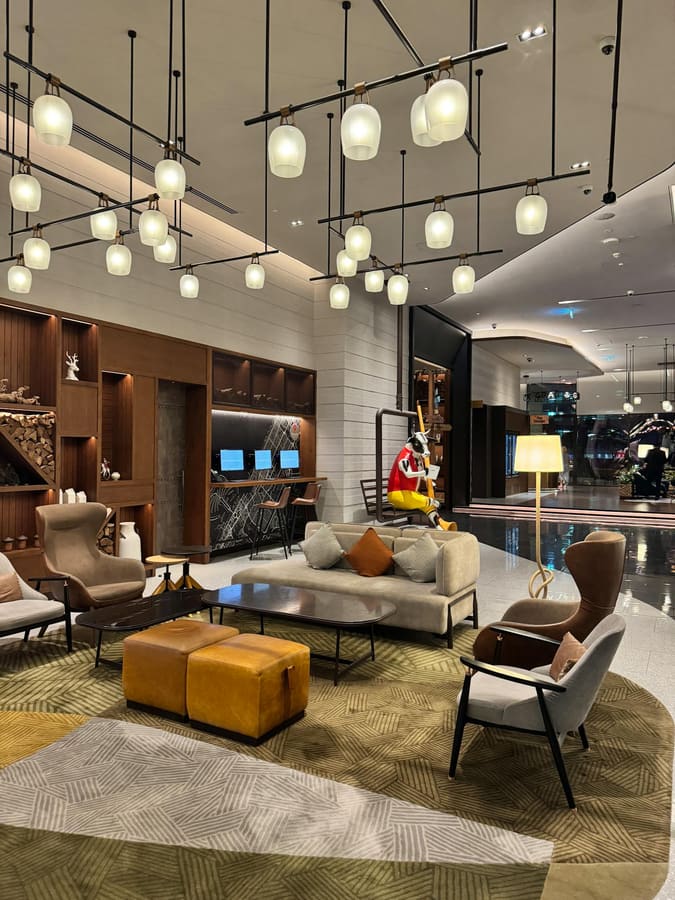
In a Panama hotel, air conditioning is the heaviest line on the electric bill, and most of that consumption happens in empty rooms: the guest leaves at nine in the morning with the AC at 18 degrees and returns at seven in the evening. Hotel automation exists, first and foremost, to solve that. This guide explains what gets automated, how it integrates with what you already have, and what to demand when you ask for proposals.
What gets automated in a room
Presence. A presence sensor and the door contact tell the system whether anyone is in. When the room is empty for more than twenty minutes, the AC drops to eco mode (say, 26 degrees instead of 21) and the lights go off. When the guest returns, the room recovers in minutes. The guest notices nothing; the bill does.
Climate. A thermostat per room with configurable limits: the guest can choose between 20 and 25 degrees, not 16. Windows and balconies with contacts: if they open, the AC pauses.
Lighting and curtains. A welcome scene at check-in, a night courtesy light, curtains that close on their own during peak sun hours to save on cooling.
Service. "Do not disturb" and "make up room" buttons connected to the housekeeping system, instead of the cardboard sign on the handle.
PMS integration
The property management system (Opera, Cloudbeds, Mews, Protel or whichever you use) knows which rooms are occupied, which arrive today and which check out. Integrating automation with the PMS makes it possible to:
- Prepare the room (climate and lights) thirty minutes before the expected check-in, not all day.
- Put unreserved rooms into deep energy-saving mode.
- Notify housekeeping as soon as a room checks out.
- Report consumption per room and per room-night sold, the indicator that really matters.
Integration uses open protocols (BACnet, Modbus, the PMS API) without changing your PMS.
Common areas and back of house
What proposals forget most often: lobby, corridors, gym, pool, event rooms, kitchen and laundry. Schedules, presence sensors and equipment monitoring apply here: pumps, chillers, water heaters. An event room with the AC running all night after a wedding costs more than automating ten rooms.
When the hotel exceeds 3,000 square meters or has chillers, elevators and generators operated separately today, a BMS (building management system) supervising everything from one panel makes sense. Below that, zoned KNX is usually more cost-effective.
Why KNX in a hotel
In a hotel, KNX's decentralized architecture matters even more than in a house. With a central controller, one failure shuts down the whole hotel. With KNX, each room works on its own: a problem affects one room, not a hundred. And because it is an open standard with 500+ manufacturers, you do not depend on a single supplier over the building's twenty-year life. International chains use it for exactly that reason.
How much is saved and how fast
In typical commercial projects we see a 15% to 30% reduction in air-conditioning consumption, the heaviest line on a hotel's bill. The figure depends on occupancy, the type of AC and how much is wasted today. A hotel with window units and no control has more headroom than one with an old BMS.
Timelines: a full hotel with KNX, PMS integration and BMS takes three to six months, coordinated with the electrical works if it is new construction. A pilot floor in an operating hotel is done in weeks and measures the real savings before scaling up.
What to put in a tender
If you are going out to bid, these clauses protect you:
1. Open protocols (KNX, BACnet, DALI, Modbus) named explicitly. It keeps you from being locked to one supplier.
2. Local processing: the hotel must operate without internet and without any manufacturer's cloud.
3. Integration with the current PMS, documented, not "possible in the future".
4. Exportable consumption reports per room.
5. Staff training and the programming documentation handed over to the hotel.
6. Support with a defined SLA and direct contact, not a ticket portal.
7. KNX Partner certification of the integrator, verifiable at knx.org.
Starting without stopping the hotel
The most sensible way to start is a pilot floor: ten or fifteen rooms are automated, integrated with the PMS, and consumption is measured for two months against a non-automated floor. With that figure in hand, the decision to scale stops being an act of faith. DiraSmart does the site visit free of charge and delivers the pilot proposal in writing.